



Infrared Roof Inspection in Roswell, NM
Discover hidden roof issues with our infrared inspection in Roswell, NM. Efficient leak detection and maintenance advice. Schedule your roof analysis now!
Are Hidden Roof Issues Threatening Your Home's Safety?
Noticing higher energy bills or unexplained water stains? Our infrared roof inspection can uncover hidden problems before they turn into major repairs. Contact us today to schedule your comprehensive roof analysis and secure your property.
- Detects and diagnoses leaks and insulation faults efficiently.
- Provide documented insights with actionable recommendations.
- Utilize state-of-the-art equipment manned by certified inspectors.
Backed by comprehensive insurance and industry-standard certifications, ensuring peace of mind.
Design Roof Services LLC utilizes advanced thermal imaging technology to identify moisture intrusion and energy loss that the naked eye simply cannot see. For property owners in Roswell, NM, this non-destructive testing method provides critical data, allowing you to make informed decisions about maintenance and repairs without unnecessary guesswork or invasive procedures.
Comprehensive Thermal Analysis: Scope and Deliverables
When you commission an infrared roof inspection, you are purchasing certainty. Standard visual inspections are limited to surface-level defects, cracked tiles, torn membranes, or rusted flashing. However, the most dangerous threats to a roofing system occur beneath the surface. Water infiltration often travels laterally, meaning the wet insulation may be far from where the visible leak appears inside the building.
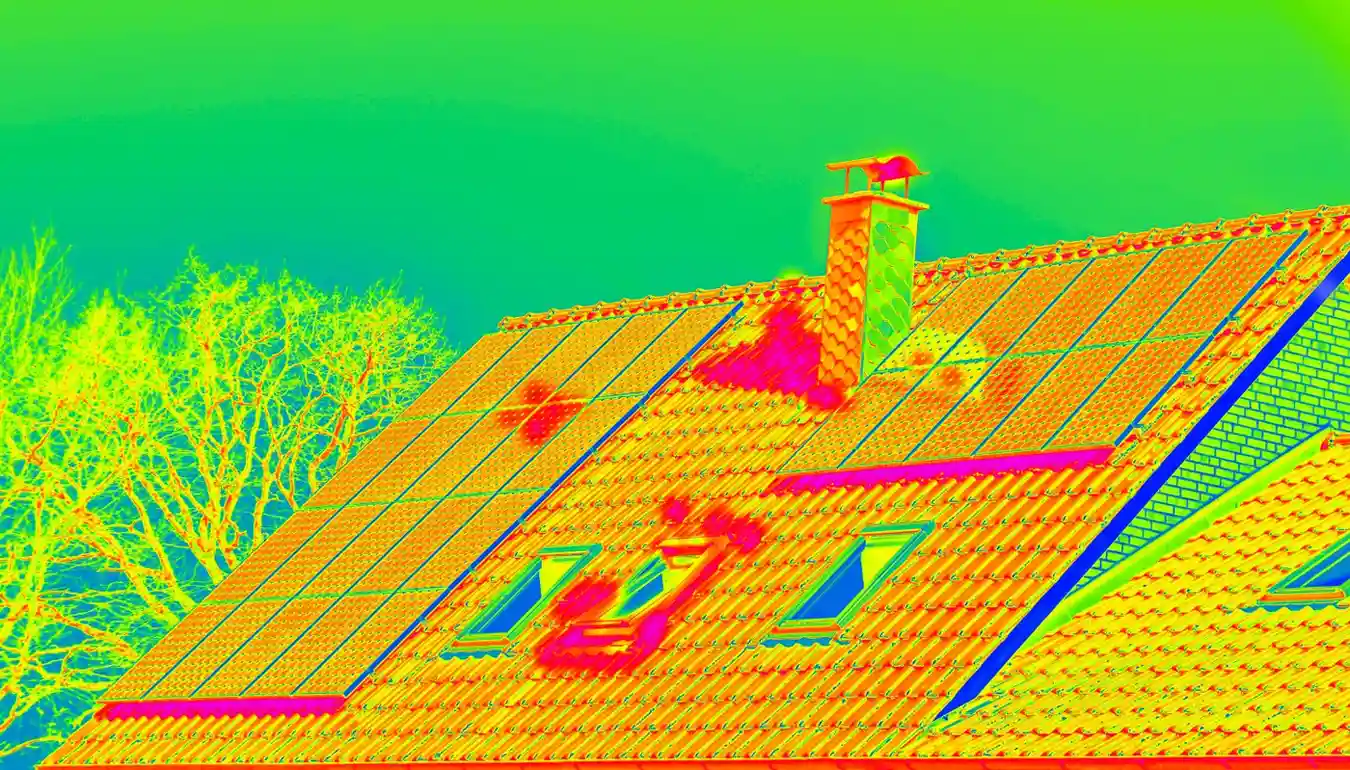
Our service focuses on detecting thermal anomalies that indicate trapped moisture. Because wet insulation retains heat longer than dry insulation, our high-resolution thermal cameras can pinpoint exact areas of saturation as the roof cools down after sunset. This differential in temperature creates a clear thermal signature, allowing us to map out damaged areas with precision.
The scope of this inspection includes a full scan of the roofing system, focusing on high-risk areas such as penetrations, seams, and drainage points. We analyze the thermal retention of the substrate to differentiate between surface heat and subsurface moisture. This process is effective across various roofing materials common in the region, including TPO, EPDM, built-up roofing (BUR), and modified bitumen.
Upon completion, you receive a detailed, technical report. This document is not merely a checklist but a comprehensive audit of your roof’s health. It includes:
- High-resolution infrared images showing the thermal anomalies.
- Corresponding digital photographs for visual reference.
- A graphical markup of the roof plan indicating wet areas.
- Quantification of the affected surface area to assist in budgeting.
- Recommendations for surgical repairs versus total system replacement.
This level of detail is essential for insurance claims, real estate transactions, and capital budget planning. It ensures that you pay only for the repairs you need, rather than replacing a mostly sound roof due to a lack of accurate data.
Technical Execution: How We Perform Your Assessment
The effectiveness of an infrared inspection relies heavily on environmental conditions and precise timing. We do not simply fly a drone or walk a roof at noon; the physics of thermal capacitance requires specific protocols to ensure accuracy.
The process begins with an evaluation of the weather conditions. For a successful scan, the roof needs a dry surface and a day of solar loading (sunlight) followed by a rapid cooling period in the evening. This contrast highlights the "hot spots" where moisture is trapped.
Site Preparation and Safety Analysis
Before any equipment is deployed, we conduct a safety assessment of the perimeter and access points. We verify that the roof surface is free of standing water or debris that could skew thermal readings. We also coordinate with facility managers to ensure access does not disrupt daily operations.
The Thermal Scan
Our certified thermographers conduct the scan during the optimal thermal window, typically starting shortly after sunset. We systematically traverse the roof, using handheld thermal imagers to scan every square foot. In cases of large commercial structures or difficult-to-access areas, we may utilize aerial thermal imaging to capture a holistic view of the thermal envelope.
Verification and Core Sampling
Thermal images show temperature differences, not water directly. Therefore, verification is a non-negotiable step in our process. When an anomaly is detected, we use non-invasive moisture meters to confirm the presence of water. In some scenarios, a small core cut (which is immediately patched) may be taken to physically verify the saturation levels of the insulation and the condition of the deck.
Data Interpretation and Mapping
The raw data is analyzed to distinguish between true moisture intrusion and false positives caused by reflectivity, shadows, or different material thicknesses. We map these findings directly onto a CAD drawing or roof plan, creating a clear blueprint of where the roof system has failed.
Final Reporting
The collected data is synthesized into the final deliverable. This report is reviewed for accuracy and delivered promptly, often within 24 to 48 hours depending on the project size, ensuring you have the information needed to approve repairs immediately.
Data-Driven Decisions: Targeted Repairs vs. Full Replacement
One of the most significant financial risks for property owners is replacing a roof prematurely. Conversely, attempting to patch a roof that is fully saturated is a waste of maintenance budget. Infrared technology provides the quantitative data required to choose the correct path.
If an inspection reveals that less than 20% to 25% of the roof’s insulation is wet, a restoration or targeted repair strategy is usually the most cost-effective option. We can clearly delineate the wet areas, allowing contractors to remove only the damaged sections and patch the membrane. This extends the life of the existing asset for a fraction of the cost of a tear-off.
However, if the scan shows widespread saturation exceeding 30% or 40%, or if the moisture has compromised the structural integrity of the deck, full replacement becomes the logical investment. In this scenario, the infrared report serves as undeniable proof for stakeholders or insurance adjusters that a total replacement is necessary.
By utilizing infrared technology, you move from reactive maintenance based on guesses to proactive asset management based on facts. You avoid the "chasing leaks" cycle, where money is continuously poured into ineffective patches while the underlying insulation rots away.
Navigating Local Climate Challenges and Requirements
Operating in Roswell, NM, requires a specific understanding of how the local climate impacts roofing systems. The high desert environment subjects roofs to extreme thermal shock. During the summer, roof surface temperatures can exceed 160°F, causing significant expansion of membranes and metal flashings. At night, or during winter, these materials contract rapidly.
Thermal Expansion and Seam Failure
This constant expansion and contraction cycle puts immense stress on seams and flashings. Over time, this leads to micro-tears and adhesion failure. Infrared inspections are particularly adept at catching the early signs of moisture entry at these stress points before they manifest as interior drips.
Winter Freeze-Thaw Cycles
While winters here are generally mild, temperatures frequently dip below freezing. Moisture trapped in roof insulation will freeze and expand, causing further delamination of the roof system and potentially cracking the substrate. Identifying and removing wet insulation before the freeze-thaw cycle begins is critical to preserving the building's structure, visit our blog for maintenance tips.
Storm Damage and Sudden Infiltration
Though annual precipitation is low, the region experiences intense storms that drop large volumes of water quickly. A roof that appears watertight during a light rain may fail catastrophically during a deluge. Our inspections identify the hidden pathways that only become active during these high-volume events.
Regarding permits and regulations, while the inspection itself generally does not require a municipal permit, the subsequent repairs identified often do. We assist in providing the necessary technical documentation to justify repair scopes to local building departments, streamlining the approval process for any required remediation.
Why Technical Precision Matters
Choosing the right partner for infrared services is not about finding the lowest bidder; it is about finding the most accurate interpreter of data. A thermal camera in untrained hands is liable to misinterpret HVAC exhaust heat, reflective glare, or membrane patches as leaks. This leads to unnecessary repairs or, worse, ignored problems.
We employ high-sensitivity equipment capable of detecting minute temperature differentials. Our inspectors are trained to understand building envelope physics, heat transfer, and thermodynamics. This expertise ensures that false positives are eliminated and only genuine defects are reported.
We prioritize speed and clarity. We understand that if you are requesting an inspection, you likely suspect an issue or have a transaction pending. Our workflows are designed to get inspectors on-site quickly and reports in your inbox without delay. We carry full liability insurance and adhere to strict safety protocols, protecting your property and our personnel throughout the operation.
With Design Roof Services LLC, you receive an objective, unbiased assessment of your roof’s condition. We provide the intelligence you need to negotiate real estate deals, file accurate insurance claims, and manage your facility’s maintenance budget with confidence.
Secure Your Roof’s Integrity Today
Don't wait for water to drip on your inventory or equipment to address roofing issues. Hidden moisture compromises energy efficiency, structural safety, and indoor air quality. Get a definitive diagnosis of your roof’s condition.
Contact our team now to schedule your infrared roof inspection and stop hidden damage in its tracks.

Customer Testimonials
Go With Experience