



Infrared Roof Inspection in Artesia, NM
Discover hidden roof damage in Artesia with our infrared inspections. Contact us for precise thermal analysis that prevents costly repairs and optimizes your maintenance budget.
Detect and Address Roof Issues Effectively with Infrared Inspection
Concerned about potential roof damage or undetected leaks? Infrared roof inspections can reveal hidden problems and prevent costly repairs. If you suspect moisture intrusion or insulation failure, contact us today to schedule your comprehensive thermal analysis.
For property owners in Artesia, NM, relying solely on visual inspections often leaves critical issues unnoticed until they become catastrophic failures. Water infiltration creates invisible pathways beneath the membrane, saturating insulation and rotting structural decking without showing immediate surface signs. Design Roof Services LLC utilizes advanced thermal imaging technology to identify these anomalies with precision, providing the data necessary to make informed maintenance decisions.
- Immediate revelation of active water intrusion and energy-wasting insulation gaps.
- Detailed, same-day inspection reports that pinpoint exact damage locations.
- Accurate detection that minimizes the scope of repairs and future capital expenditure.
All inspections are carried out by certified professionals, with detailed reports provided the same day to ensure you have actionable intelligence immediately.
Professional Infrared Inspections to Secure Your Roof
The integrity of a roofing system relies on more than just the visible surface layer. While a roof may appear watertight during a walkthrough, the layers beneath, specifically the insulation and substrate, can hold trapped moisture for months or even years. This trapped moisture significantly degrades the R-value of the insulation, increases energy costs due to thermal bridging, and accelerates the corrosion of steel decks or the rotting of wood decks.
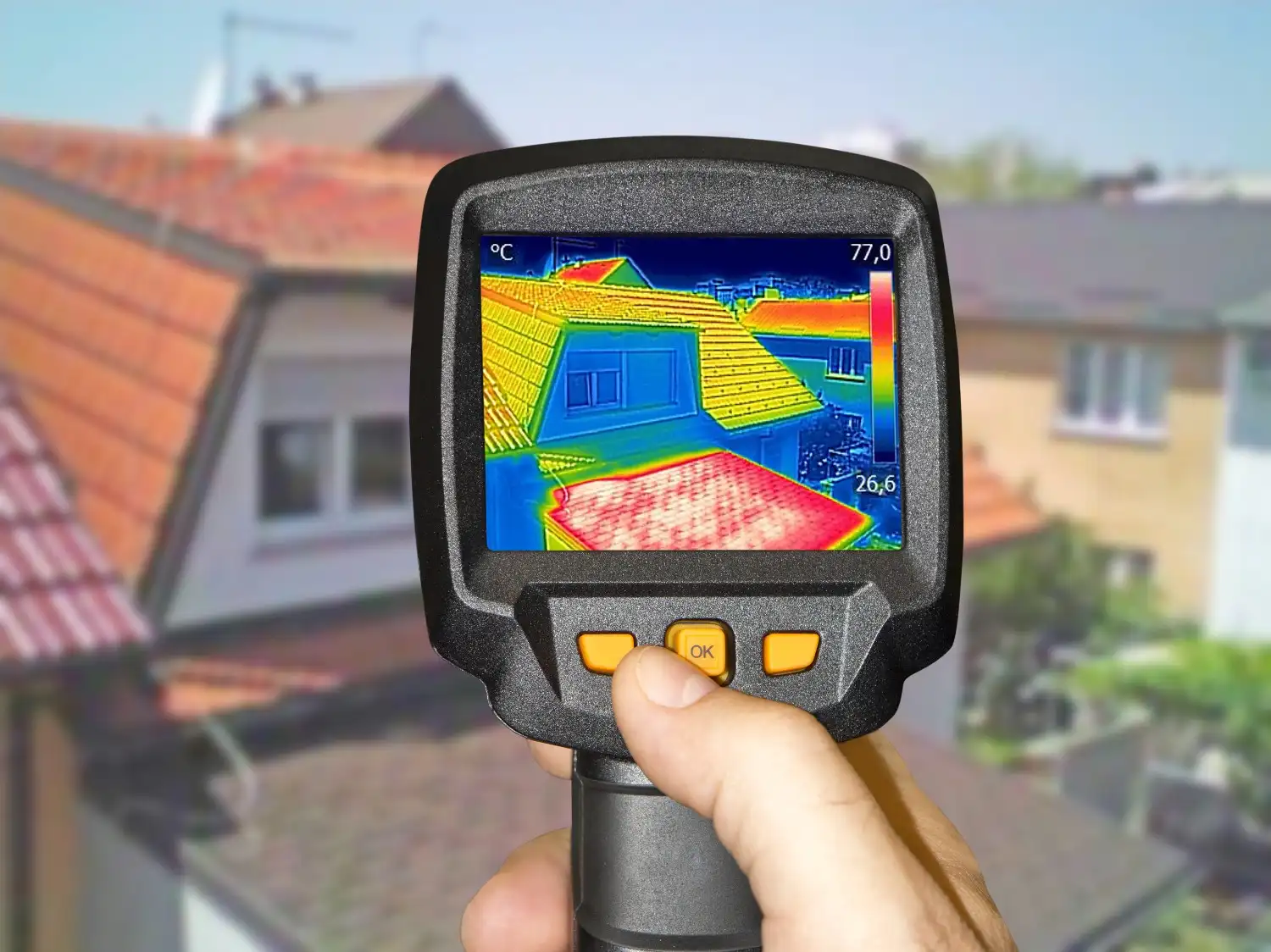
Infrared (IR) inspection, also known as thermography, is a non-destructive testing method that detects these issues by measuring temperature differentials. As the sun sets, dry roof insulation cools down faster than wet insulation. Water has a higher thermal mass, meaning it retains heat longer. Our thermal cameras detect this heat signature, allowing us to map out the precise boundaries of moisture saturation beneath the roof membrane. This approach transforms a guessing game into a scientifically backed assessment, ensuring that capital budgets are spent on necessary repairs rather than unnecessary full replacements.
What Our Infrared Inspection Entails: Process, Technologies Employed, and Immediate Report Generation
Our service is designed to provide comprehensive data regarding the health of your low-slope or flat roof. We move beyond simple "pass/fail" assessments to provide a granular view of your roof's condition. The core of this service involves high-resolution thermal imagers that capture radiometric JPEGs, allowing for post-process temperature analysis.
The inspection covers the entire field of the roof, focusing on high-risk areas such as penetrations, flashings, drains, and parapet walls. We differentiate between surface artifacts, such as reflective coatings or debris, and genuine subsurface thermal anomalies.
- High-Resolution Thermal Scanning: We utilize industrial-grade infrared cameras capable of detecting minute temperature differences (thermal sensitivity of <30mK). This sensitivity is crucial for identifying early-stage leaks where the moisture content is low but growing.
- Visual Confirmation and Core Verification: Thermal images identify "anomalies," but professional verification confirms "leaks." We correlate thermal findings with visual evidence and, when necessary, perform non-invasive moisture meter readings or minimally invasive core cuts to verify the presence of water.
- Drone-Assisted Thermography: For large industrial complexes or hard-to-access areas in Artesia, we employ aerial thermal imaging. This provides a top-down orthomosaic view, creating a complete thermal map of the building envelope without safety risks associated with walking on compromised structures.
- Actionable Reporting: You receive a detailed report the same day or within 24 hours. This document includes side-by-side comparisons of digital photos and thermal images, clearly marking areas of wet insulation. The report serves as a bid document, allowing contractors to quote repairs based on exact square footage of saturated material rather than estimates.
Inspection Process: From Setup to Report Delivery
A successful infrared inspection requires strict adherence to environmental and procedural protocols. We do not simply show up and point a camera; the conditions must be conducive to creating the "thermal window" necessary for accurate data collection.
- Pre-Inspection Weather Analysis: We monitor local weather conditions closely. For a valid scan, the roof needs a clear, sunny day to absorb solar energy (thermal loading) followed by a clear evening to allow for radiative cooling. We ensure the roof surface is dry and free of ponding water, as surface water can mask subsurface thermal patterns.
- Sunset Deployment: The inspection typically begins shortly after sunset. This is when the temperature difference (Delta T) between dry and wet insulation is most distinct. The transition from day to night creates a window of 2 to 4 hours where thermal contrast is highest.
- Systematic Grid Scanning: We traverse the roof in a systematic pattern to ensure 100% coverage. Every section of the roof is viewed through the thermal lens. Operators adjust span and level settings on the camera to isolate the specific temperature range of the roof assembly, filtering out background noise from HVAC units or vents.
- Anomaly Marking: When a thermal anomaly is located, we mark the roof surface with spray paint or markers directly on the membrane. This physical marking is critical for repair crews, ensuring they know exactly where to remove saturated materials.
- Data Verification: Before concluding the survey, we cross-reference thermal data with moisture meters. This step rules out false positives caused by heavy gravel ballast, reflective coatings, or different insulation thicknesses that might mimic a heat signature.
- Report Compilation: Data is offloaded and analyzed using specialized software. We tune the thermal images to highlight the problem areas and compile the findings into a PDF format that meets insurance and industry standards.
Determining When Infrared Detection Points to Repair or Replacement
One of the primary financial benefits of infrared inspection is its ability to dictate the scope of work. Property managers often face the dilemma of whether to patch a roof or tear it off completely. Thermal imaging provides the quantitative data required to make that decision based on facts rather than fear.
If the thermal scan reveals that less than 20-25% of the roof's insulation is saturated, a restoration or targeted repair strategy is usually the most cost-effective path. In this scenario, the contractor cuts out only the wet areas marked during our inspection, replaces the insulation, and patches the membrane. The rest of the roof, which is dry and structurally sound, remains in place. This can save tens of thousands of dollars compared to a total tear-off.
Conversely, if the scan detects widespread moisture entrainment exceeding 25-30% of the total surface area, or if the moisture is migrating extensively between layers, a full replacement may be validated. Design Roof Services LLC helps you reach this conclusion with definitive proof. In many cases, the cost of the infrared inspection is recouped immediately by avoiding the replacement of dry, functional roofing materials. Additionally, identifying and removing wet insulation stops the degradation of the structural deck, preventing safety hazards that could close a building.
Adapting to Artesia’s Climate: Tailoring Inspections to Seasonal Needs
Operating in Artesia requires an understanding of the specific high-desert climate and its impact on roofing systems. The distinct weather patterns here dictate not only when inspections should occur but also what types of failures are most common.
- Summer Thermal Loading: The intense heat during Artesia summers works to our advantage during inspections. High daytime temperatures ensure the roof assembly absorbs significant solar energy. This creates a strong thermal contrast after sunset, making summer an ideal time for highly accurate scans. However, the extreme UV exposure can cause rapid degradation of exposed sealants, which we look for as entry points for moisture.
- Monsoonal Moisture Intrusion: July and August often bring monsoonal thunderstorms with heavy, rapid rainfall. These events stress the roof's drainage systems. Infrared scans performed shortly after these storm cycles are incredibly effective at catching leaks that penetrate flashings or seams before the water has time to evaporate or wick deep into the building.
- Winter Freeze-Thaw Cycles: While winters are generally mild, temperatures do drop below freezing. If moisture is present in the roof assembly during these drops, it freezes and expands. This expansion delaminates membrane seams and cracks rigid insulation. Conducting a scan in late autumn helps identify and dry out these areas before freezing temperatures exacerbate the damage.
- Low Precipitation Considerations: Because annual rainfall is low, leaks can remain "silent" for long periods. Water may enter the system but not drip into the interior immediately. It accumulates in the insulation, rotting the deck unnoticed. Regular thermal scans are the only way to detect this "dry climate" rot before the roof deck loses its structural load-bearing capacity.
Why Trust Us: Certified Expertise and Proven Local Experience
Interpreting thermal images is both a science and an art. A thermal camera in untrained hands can lead to costly misdiagnoses, as shadows, vents, and different material types can all look like moisture to the uninitiated. We employ certified thermographers who understand the physics of heat transfer and the specific construction methods used in commercial roofing.
We utilize equipment that meets or exceeds industry standards for resolution and thermal sensitivity. Our focus is strictly on providing accurate, unbiased data. We do not have a vested interest in selling you a new roof; our goal is to provide the diagnostic clarity you need to manage your asset effectively. By combining local knowledge of Artesia’s building codes and climate with top-tier technology, we deliver reports that stand up to scrutiny from insurance adjusters and engineering firms.
Maintaining a commercial roof requires more than guesswork; it requires actionable data. Whether you are preparing a budget for the next fiscal year, validating a new roof installation, or investigating a persistent leak, an infrared inspection provides the visibility you need. Design Roof Services LLC is ready to help you extend the lifespan of your roof and protect your investment.
Secure your property with a data-driven inspection today.
Advanced Diagnostics Delivered With Imaging Precision
Using infrared roof inspection in Artesia, NM, allows property managers to detect hidden moisture and heat loss without disruptive testing. Design Roof Services LLC uses thermal imaging technology to analyze system performance and locate problem areas with precision. Our consultants interpret the data to deliver insights that inform smarter decisions. We help prevent structural issues by addressing conditions early. Gain deeper visibility into your roofing system through non-invasive inspection.
Identify Hidden Issues With Thermal Accuracy

Customer Testimonials
Go With Experience