



Infrared Roof Inspection in Hobbs, NM
Discover hidden issues in your roofing system with our Infrared Roof Inspection services in Hobbs, NM. Contact us today to schedule your professional assessment and ensure the longevity of your roof.
Discover the Hidden Problems in Your Roof with Infrared Inspection
Worried about unseen damage to your roof? Infrared roof inspections can reveal hidden issues like moisture leaks and insulation faults before they turn into costly repairs. Contact us today to discuss your facility's needs or schedule an assessment.
In Hobbs, NM, the harsh sun and sudden monsoonal rains can compromise roofing systems in ways that are invisible to the naked eye until it is too late. Design Roof Services LLC utilizes advanced thermal technology to spot these issues early, preventing structural rot and saving you thousands in capital expenditures.
- Identify potential leaks and insulation issues without invasive methods or destructive testing.
- Receive a comprehensive report detailing the condition of your roof, complete with thermal images and analysis.
- Benefit from the expertise of certified inspectors using the latest technology to verify membrane integrity.
All inspections are carried out by licensed professionals with a focus on safety and accuracy.
Why Infrared Roof Inspections are Essential
Standard visual inspections are a crucial part of building maintenance, but they are limited by what the human eye can see. A roof surface might look pristine, with no obvious tears, punctures, or blistering, yet the substrate beneath could be saturated with water. Moisture entrainment within roof insulation is a silent destroyer of commercial and residential structures. When water infiltrates the roof assembly, it significantly reduces the R-value (thermal resistance) of the insulation, leading to massive energy inefficiencies. More critically, trapped moisture accelerates the corrosion of metal decks and the rotting of wood structures, compromising the physical safety of the building.
Infrared (thermal) inspection bridges the gap between surface appearance and structural reality. By detecting temperature differentials across the roof surface, we can pinpoint exactly where moisture is trapped. Water has a higher thermal mass than dry insulation. As the roof cools down after sunset, the areas holding water retain heat longer than the dry areas. Our thermal imagers visualize this temperature difference, creating a clear map of wet insulation. This allows property owners to address specific problem areas rather than paying for a full roof replacement when only surgical repairs are necessary.
For facility managers and homeowners, this approach shifts roof management from a reactive stance to a predictive one. Instead of waiting for a leak to drip onto the warehouse floor or damage drywall, you identify the point of entry and the extent of saturation immediately. This data is vital for warranty claims, real estate transactions, and long-term capital planning.
What You Get: Detailed Insights into Your Roof’s Health
When you commission an infrared inspection, you are purchasing actionable data rather than vague approximations. The primary deliverable is clarity regarding the boundary between wet and dry materials. This distinction is the most important factor in determining whether a roof can be restored or if it requires a complete tear-off.
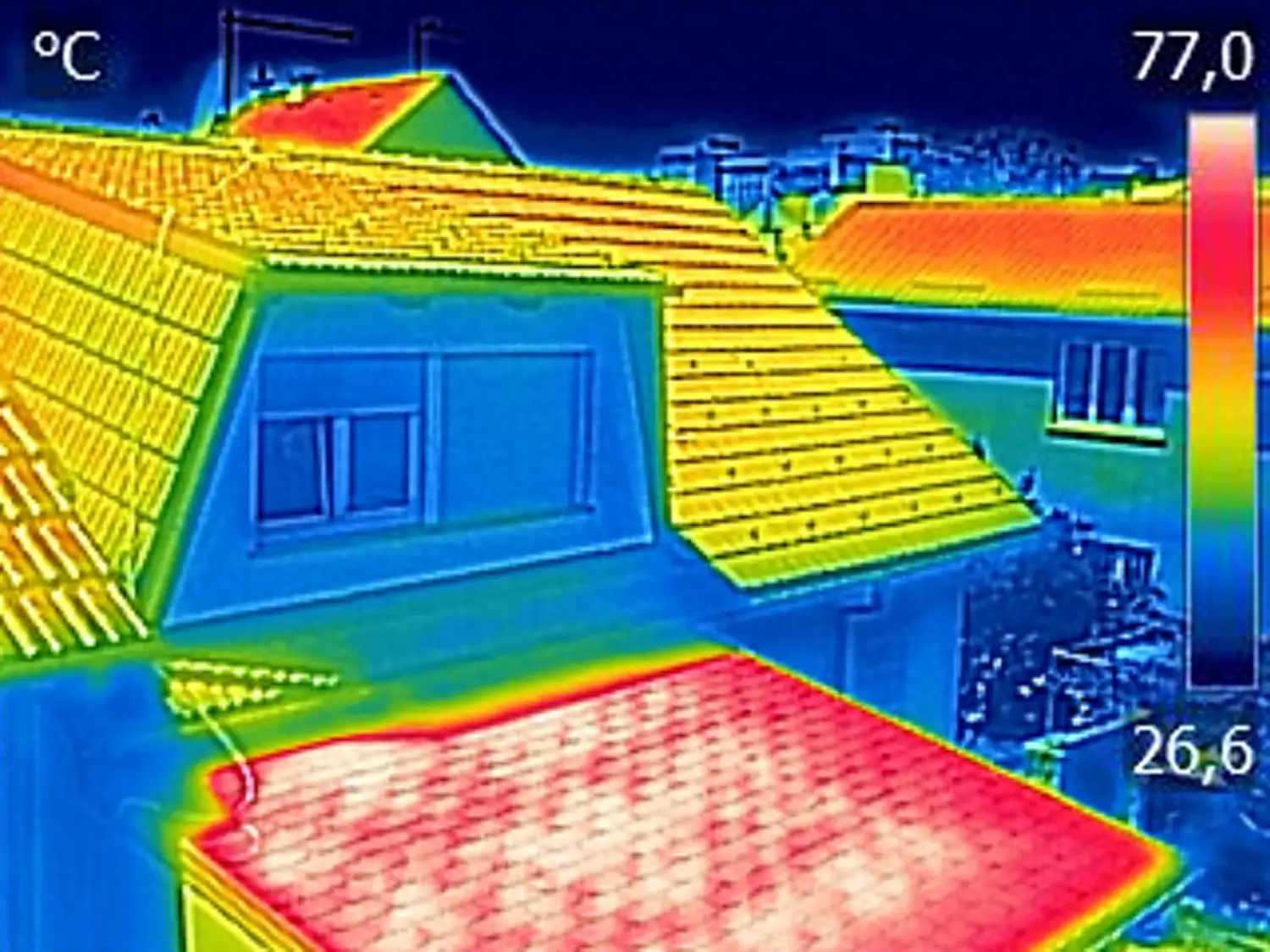
Our service provides a comprehensive analysis that translates thermal patterns into real-world conditions. We do not simply hand over a collection of colorful pictures; we provide an interpreted assessment that explains what those thermal anomalies mean for the longevity of your roof system.
- High-Resolution Thermal Imagery: You receive clear thermal images showing the exact location and shape of moisture intrusion. These images highlight the thermal footprint of wet insulation, distinguishing it from dry areas and mechanical heat sources.
- Corresponding Visual Photographs: For every thermal image, we provide a standard digital photograph of the same area. This side-by-side comparison allows contractors to locate the specific area on the roof easily during the repair phase.
- Moisture Mapping: We delineate the affected areas directly on the roof surface or provide a CAD drawing indicating the square footage of wet insulation. This metric is essential for obtaining accurate repair bids.
- Verification Data: Thermal anomalies can sometimes be caused by factors other than moisture, such as heavy gravel or different material layers. We validate our thermal findings with core cuts or non-invasive moisture meter probing to confirm the presence of water.
- Actionable Recommendations: The report concludes with an assessment of the overall roof health, helping you decide if the level of saturation warrants a restoration coating, patch repairs, or a reroofing project.
How Our Infrared Inspections Work: From Setup to Report
The process of an infrared scan is scientific and requires precise timing and conditions to ensure accuracy. It is not simply a matter of walking the roof with a camera; the environment must be right to create the necessary thermal load. The roof must be dry and free of ponding water, as surface water can mask the thermal signature of subsurface moisture.
- Pre-Inspection Analysis: We evaluate the roof type, access points, and safety requirements. We also monitor local weather patterns in Hobbs to ensure the days leading up to the scan have been dry enough for accurate readings.
- Solar Loading: The inspection relies on the sun heating the roof throughout the day. This "solar loading" puts energy into the roof system. The inspection typically occurs after sunset, once the ambient temperature drops and the roof surface begins to cool.
- The Thermal Scan: Our inspectors traverse the roof in a systematic grid pattern. We use high-sensitivity infrared cameras to scan the entire surface. We look for the characteristic heat signatures that indicate trapped moisture, areas that are glowing "warm" while the rest of the roof cools down.
- On-Site Verification: When a thermal anomaly is detected, we do not assume it is water. We verify the finding immediately using a moisture probe or a gravitational core sample. This confirms that the temperature differential is indeed caused by fluid saturation and not a structural anomaly or reflection.
- Marking the Surface: Upon confirmation, we physically mark the perimeter of the wet area on the roof surface or paint (if requested and appropriate for the roof type). This serves as a guide for repair crews.
- Report Generation: After the field work is complete, the data is analyzed in our office. Images are tuned for maximum clarity, and a formal report is compiled, documenting the findings and calculating the percentage of the roof that is compromised.
When to Choose Infrared Inspection Over Standard Assessments
While annual visual inspections are necessary for general housekeeping, clearing drains, checking flashings, and removing debris, there are specific scenarios where an infrared inspection is the only logical choice. Relying solely on visual checks in these situations involves a high degree of financial risk.
If you are preparing to apply a new liquid-applied membrane or a cool roof coating, an infrared scan is mandatory. Applying a new coating over wet insulation seals the moisture inside. As the sun heats that trapped moisture, it turns to vapor, expands, and causes the new coating to blister and delaminate. Design Roof Services LLC ensures you have a dry substrate before you invest in restoration, protecting your warranty and your investment.
- Real Estate Due Diligence: Before purchasing a commercial building, you need to know the true condition of the roof. A visual walk-through will not reveal if the insulation is 30% saturated. An infrared scan provides leverage in negotiations and prevents post-closing surprises.
- Post-Storm Verification: After a severe storm event, visible damage might be minimal, but membrane adhesion could be compromised. An infrared scan can detect if water was forced under the membrane during high wind events.
- Leak Investigation: When a leak is active inside the building but the entry point on the roof is not obvious, infrared can trace the path of the water. Water often travels laterally along the deck before dripping; thermal imaging reveals this migration path.
- Warranty Expiration: Before your roof warranty expires, it is prudent to conduct a scan. If moisture is found, you may have a valid claim for repairs before the financial burden shifts entirely to you.
Local Considerations in Hobbs: Climate and Service Specifics
Conducting infrared inspections in Hobbs, NM, requires an understanding of the local climate cycles. The region presents a unique mix of high desert conditions that influence both how roofs age and how inspections must be timed.
Summer Heat and Monsoons
Summers in Hobbs see highs frequently exceeding 90°F. This intense heat causes significant thermal expansion in roofing materials. Over time, this movement creates stress on seams and flashings. Later in the summer, the area experiences periodic monsoonal rains. These sudden, heavy downpours can overwhelm drainage systems and force water into small voids created by thermal expansion. An infrared inspection is particularly effective in late summer or early fall to catch moisture intrusion resulting from these seasonal storms.
Winter Freeze-Thaw Cycles
Although winters are generally dry, lows in the 20s°F mean that any trapped moisture within the roof assembly will freeze and expand. This expansion damages the cell structure of insulation and can crack concrete decks. Identifying and removing wet insulation before the freezing temperatures set in is critical to preserving the roof deck.
Optimal Scanning Conditions
The clear, sunny days common in Hobbs are ideal for infrared thermography. High solar gain during the day ensures the roof absorbs plenty of heat, while the clear night skies allow for rapid radiative cooling of the dry areas. This creates a sharp, high-contrast thermal image that makes identifying wet insulation highly accurate. We monitor these weather windows closely to ensure we deploy our teams when the data will be most reliable.
Your Safety and Satisfaction, Our Promises and Credentials
The integrity of an infrared inspection depends entirely on the skill of the thermographer and the quality of the equipment. Using low-resolution cameras or misinterpreting thermal patterns can lead to false positives (identifying dry areas as wet) or false negatives (missing actual leaks). We utilize industrial-grade infrared cameras with high thermal sensitivity, capable of detecting minute temperature differences that consumer-grade tools miss.
Our process is non-destructive. Aside from the small validation core cuts (which are immediately patched and sealed to industry standards), we do not damage the roof to inspect it. This keeps your building watertight while we gather the necessary data. We operate with strict adherence to safety protocols, ensuring that all personnel on your roof are equipped with proper fall protection and personal protective equipment.
We understand that a roof report is a tool for decision-making. Whether you need to justify a budget request to a board of directors, provide evidence to an insurance adjuster, or simply plan your maintenance schedule for the next five years, our reports are designed to be clear, authoritative, and defensible. We act as an unbiased third party, focusing strictly on the data provided by the physics of the roof system.
Protect your asset from the inside out. Don't wait until water is dripping on your inventory or equipment to investigate your roof's condition.
Secure the longevity of your building envelope today. Contact Design Roof Services LLC to schedule your professional infrared roof analysis.
Detailed Diagnostics For Informed Roofing Decisions
Standard inspections may overlook critical issues beneath the surface. Design Roof Services LLC conducts advanced evaluations through its infrared roof inspection in Hobbs, NM, detecting moisture intrusion and concealed deficiencies within the system. Our certified process delivers accurate findings without invasive testing, helping property managers plan targeted repairs or improvements. Each inspection includes documented results and recommendations based on system condition. Identify problems early with technology-driven accuracy.
Detect Subsurface Concerns With Precision Inspection Methods

Customer Testimonials
Go With Experience