



Infrared Roof Inspection in Lovington, NM
Discover hidden roof issues with our Infrared Inspection Services in Lovington, NM. Ensure your roof's integrity with our non-invasive, accurate technology. Contact us today!
Worried About Your Roof's Integrity? Infrared Inspection Can Help
Facing unexpected roofing issues can be stressful, especially with the erratic weather patterns common in Lovington, NM, where hidden moisture can rapidly degrade structural integrity. Design Roof Services LLC provides specialized infrared roof inspection services that pinpoint hidden problems without invasive measures, allowing you to make informed maintenance decisions immediately. Contact us today or apply for financing online to secure your property against water damage.
- Quickly identify and address potential roof damages before they escalate into structural failures.
- Save on future costs with early detection of moisture entrapment and compromised insulation.
- Experience minimal disruption thanks to our non-invasive imaging techniques that require no physical tear-offs.
Licensed and insured for peace of mind, with flexible appointment times to suit your schedule.
What You Get Today: Comprehensive Technology, Expert Analysis
When you commission an infrared inspection, you are moving beyond simple visual guesswork and utilizing advanced thermographic technology to assess the health of your building envelope. Standard visual inspections often miss the early warning signs of water intrusion because moisture frequently travels laterally beneath the membrane before it manifests as a drip inside the building. An infrared scan detects these issues by identifying temperature differentials (Delta T) on the roof surface, providing a clear map of where water is trapped within the insulation system.
The core of this service is accuracy and actionable data. You receive a detailed report that correlates visual images with thermal images. This comparison allows property owners and facility managers to see exactly where the roof system has failed. Instead of paying for a full roof replacement based on suspicion, the data provided allows for surgical repairs. You get a precise calculation of the affected surface area, which is critical for budgeting and determining the scope of work.
Furthermore, this technology serves as a baseline for the lifespan of your roof. By establishing the current thermal performance of the roof assembly, you can monitor degradation over time. This approach shifts roofing from a reactive emergency expense to a manageable capital asset strategy. The inspection covers the entire roof surface, flashings, drainage points, and parapet walls, ensuring no potential entry point is overlooked.
How Our Infrared Inspection Works: A Step-by-Step Guide
The process of infrared thermography relies on the physical principle of thermal capacitance. Water has a higher thermal mass than dry insulation and roofing materials. This means it absorbs heat during the day and releases it more slowly at night. Our inspection process leverages this physics to identify wet insulation.
- Solar Loading Phase: The process begins during the day. The sun heats the roof surface, allowing the insulation layers beneath the membrane to absorb thermal energy. A clear, sunny day in Lovington is ideal for this phase to ensure a sufficient temperature difference between wet and dry materials later in the evening.
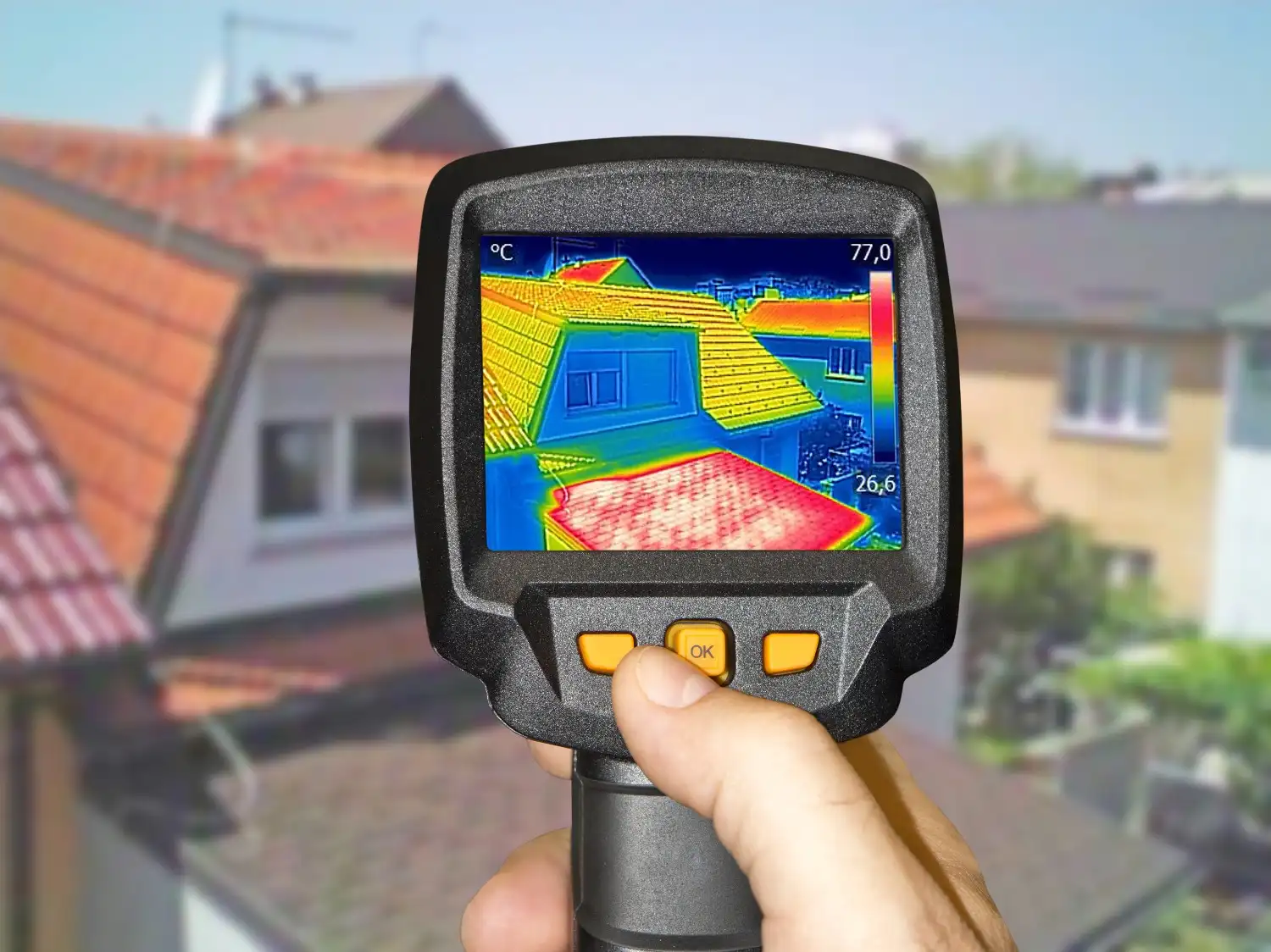
- The Inspection Window: The actual scanning takes place after sunset. As the ambient air temperature drops, the dry roof insulation cools down relatively quickly. However, areas of wet insulation retain the heat absorbed during the day for a longer period. This creates a thermal anomaly where wet areas appear "hot" or bright on the infrared camera display, while dry areas appear dark and cool.
- Scanning and Marking: A certified thermographer traverses the roof in a systematic grid pattern. When a thermal anomaly is detected, the technician investigates the specific area. To confirm that the heat signature is indeed moisture and not a false positive caused by vents, gravel displacement, or reflective coatings, a non-invasive moisture meter or a core sample may be used for verification.
- Mapping the Damage: Once an area is confirmed as wet, the boundaries are marked directly on the roof surface with paint or crayons. This physical marking is crucial for repair crews, ensuring they know exactly where to cut and replace saturated materials without disturbing the dry, functional parts of the roof system.
- Report Generation: Finally, the data is compiled into a comprehensive report. This document includes the thermograms (thermal images), corresponding digital photos, a roof diagram indicating the location of wet areas, and a summary of the findings. This report becomes the blueprint for any necessary remediation work.
When to Choose Infrared Inspection Over Traditional Methods
Deciding between a standard visual inspection and an infrared scan depends on the complexity of the roof and the specific stage of the building's lifecycle. While visual inspections are useful for identifying surface-level wear and tear, they are insufficient for diagnosing subsurface pathology.
- Pre-Purchase Due Diligence: If you are acquiring a commercial or residential property, an infrared scan is essential. A roof may look pristine on the surface, perhaps recently coated or swept, but still harbor extensive saturated insulation underneath. Discovering this after closing can lead to massive unexpected capital expenditures. An infrared scan reveals the true condition of the asset.
- Leak Tracing on Flat Roofs: Flat and low-slope roofs are notoriously difficult to diagnose because the water entry point is rarely directly above the internal leak. Water can travel dozens of feet along the deck before finding a seam to drip through. Infrared thermography traces the moisture path back to the source, eliminating the "hunt and peck" method of repair that often results in multiple failed attempts.
- Post-Storm Assessment: After severe weather events, damage isn't always visible. Hail or wind-driven debris can cause micro-fractures in the membrane that are invisible to the naked eye but allow water to seep into the insulation. An infrared scan performed shortly after a storm can identify if the watertight integrity has been breached, providing the necessary documentation for insurance claims.
- Validation of New Roof Installation: Before signing off on a new roof installation or a major restoration project, an infrared scan serves as a quality control measure. It verifies that the new materials are dry and that the installation is watertight. This provides leverage to ensure the contractor addresses any deficiencies before the final payment is released.
Local Factors Impacting Roof Health in Lovington
The environment in southeastern New Mexico places specific stress on roofing systems that makes regular thermal monitoring critical. Design Roof Services LLC understands that the semi-arid climate creates a unique set of challenges for building owners in the region.
- High Thermal Shock: Lovington experiences significant temperature swings between day and night. During the summer, roof surface temperatures can exceed 150°F and then drop rapidly after sunset. This daily expansion and contraction cycle puts immense stress on roof seams and flashings. Over time, this movement can cause adhesion failure, creating openings for water entry. Thermal imaging is excellent at detecting seam failure early.
- UV Degradation: The high altitude and frequent clear skies result in intense UV radiation exposure. UV rays break down the chemical bonds in roofing membranes, making them brittle and prone to cracking. Once the membrane cracks, the insulation below is vulnerable. Infrared scans detect the moisture that enters through these UV-induced fissures.
- Wind Uplift and Dust: Strong winds are common in the area. Wind uplift can separate the membrane from the substrate. Additionally, dust accumulation can retain moisture and obscure visual damage. Infrared technology sees through the surface dust and detects the thermal signature of moisture regardless of surface debris, ensuring that environmental factors do not hide critical failures.
The Economics of Repair vs. Replace
One of the most valuable outputs of an infrared roof inspection is the data it provides for the "repair vs. replace" decision matrix. Roofing is a significant expense, and premature replacement is a waste of capital. Conversely, repairing a roof that is too far gone is throwing good money after bad.
- The Saturation Percentage: The industry standard often suggests that if a roof has less than 20-25% moisture saturation, a restoration or targeted repair strategy is the most cost-effective route. This might involve cutting out the wet insulation, patching the membrane, and applying a silicone or acrylic coating to extend the roof's life by 10 to 15 years. Infrared scanning gives you this exact percentage.
- Energy Efficiency Implications: Wet insulation is a conductor, not an insulator. It loses its R-value (thermal resistance), allowing heat to escape in the winter and enter in the summer. This forces HVAC systems to work harder, increasing energy bills. By identifying and replacing only the wet insulation, you restore the building's energy efficiency, often resulting in utility savings that help offset the cost of the repairs.
- Capital Planning: For property managers, budgeting is key. If the scan reveals 5% saturation, the expense is categorized as maintenance (OpEx). If the scan reveals 40% saturation, a full replacement is likely necessary, which falls under capital expenditure (CapEx). Having this data allows for accurate forecasting and prevents financial surprises.
Understanding the Technology: The Physics of Detection
To trust the results, it is helpful to understand the science behind the service. Infrared cameras do not "see" water; they visualize heat. The camera is a sensor that detects infrared radiation (heat) emitted from an object.
- Thermal Mass and Inertia: The reliability of the inspection hinges on thermal inertia. Dry insulation, whether it is polyiso, expanded polystyrene, or mineral wool, has low thermal mass. It changes temperature quickly. Water has high thermal mass. It requires more energy to heat up and takes longer to cool down.
- Conditions for Success: A successful scan requires a "solar load" during the day, meaning the roof must receive direct sunlight. It also requires a dry surface; standing water or recent rainfall can mask the thermal signatures of subsurface moisture. This is why professional timing is crucial. Scanning on a cloudy day or immediately after rain will yield inconclusive results.
- Types of Roof Systems: Infrared inspections are most effective on low-slope or flat roofs with insulation boards immediately beneath the membrane. This includes TPO, PVC, EPDM, Built-Up Roofing (BUR), and Modified Bitumen systems. Metal roofs with insulation directly attached can also be scanned, though reflective surfaces require specific camera adjustments and expertise to interpret correctly.
Minimizing Risk with Non-Destructive Testing
Traditional roof analysis often involves taking core cuts, physically cutting a hole in the roof to check for moisture. While effective for that specific spot, it is destructive and only provides a data point for a few square inches. A roof is a massive system, and random core cuts can easily miss a large area of saturation just a few feet away.
- Preserving Roof Integrity: Infrared inspection is completely non-contact. The technician walks the roof or utilizes aerial drones equipped with thermal sensors. There is no drilling, cutting, or probing required during the scanning phase. This eliminates the risk of creating new leaks during the inspection process.
- Comprehensive Coverage: Unlike core cuts which provide a sample size of less than 1%, infrared scanning provides 100% coverage of the accessible roof area. Every square foot is analyzed for thermal anomalies. This holistic view ensures that you are not basing expensive decisions on incomplete data.
- Documentation for Warranty Claims: If your roof is under warranty, the manufacturer often requires proof of failure mode. Destructive testing can sometimes void warranties if not performed by an authorized contractor. Non-destructive infrared scans provide the necessary evidence of failure without altering the physical state of the roof, preserving your warranty rights while documenting the claim.
Take Control of Your Building’s Health
Ignoring potential roof issues allows minor leaks to evolve into major structural deficits, mold growth, and operational downtime. The cost of a scan is a fraction of the cost of a premature roof replacement or emergency inventory loss due to water intrusion. Design Roof Services LLC leverages cutting-edge thermal technology to give you a transparent, data-driven assessment of your roof’s condition.
Do not wait for water to drip on your inventory or equipment. Secure your investment with precise diagnostics.
Ready to see what is really happening on your roof? Contact us today to schedule your infrared roof inspection.

Customer Testimonials
Go With Experience